
 Cornish Rex vs Devon Rex: Comparing Two Curly-Coated Breeds” loading=”lazy”>
Quick Summary
While both the Cornish Rex and Devon Rex possess striking, wavy coats and high-energy personalities, they are genetically and structurally distinct breeds. The Cornish Rex features a whippet-like body with a coat containing only fine down hair, while the heavier-boned Devon Rex has an ‘elfin’ look with a coat containing all three hair types. Recognizing these genetic, dermatological, and structural differences is crucial for providing proper veterinary and home care.
As an Amazon Associate, we earn from qualifying purchases.
Popular with cat owners: Dog Ear Cleaner · Puzzle Toys · Cat Food
In my clinical practice, I often see clients who confuse the Cornish Rex with the Devon Rex. While both share a striking, wavy coat, they are entirely distinct breeds with unique genetic backgrounds, structural designs, and medical needs.
As a veterinarian, my goal is to help you look past the initial ‘alien’ aesthetic to understand what makes these two curly-coated felines so different on an anatomical and behavioral level.
Key Takeaways
- The Cornish Rex coat is caused by an LPAR6 gene mutation and consists entirely of soft down hair.
- The Devon Rex coat is caused by a KRT71 gene mutation and retains guard, awn, and down hairs.
- Cornish Rexes have a slender, arched ‘whippet’ body, while Devon Rexes have a stockier ‘pixie’ build.
- Both breeds produce sebum that easily builds up on the skin, requiring regular cleaning to prevent yeast infections.
- They are high-energy ‘Velcro cats‘ with elevated metabolic rates and high caloric needs.
- Key health risks include Hypertrophic Cardiomyopathy (HCM), patellar luxation, and Devon Rex Myopathy.
- Neither breed is truly hypoallergenic, and both are highly sensitive to cold and UV damage.
In This Article
- The Genetics of the Curl: LPAR6 vs. KRT71
- Head and Body Structure: Whippet vs. Pixie
- Dermatological Realities and Grooming Challenges
- Metabolic Demands and Nutrition
- Hereditary Health Concerns to Watch For
- Veterinary Visits and Behavior: ‘Velcro Cats’ in the Clinic
- Temperature Control and Environmental Setup
The Genetics of the Curl: LPAR6 vs. KRT71
When I examine a Cornish Rex under a microscope, the lack of guard hairs is instantly obvious. Their coat consists entirely of the soft undercoat, or down hair, which folds into delicate, uniform waves called ‘Marcel waves.’ This is caused by a recessive mutation in the LPAR6 gene.
Conversely, the Devon Rex possesses all three hair types: guard, awn, and down. Their mutation lies in the KRT71 gene, producing a coat that feels more like crushed velvet or suede.
In my clinic, I often use a trichogram to analyze these hairs when diagnosing focal alopecia.
- Cornish Rex: Missing guard hairs entirely; coat is 100% fine down hair.
- Devon Rex: Retains guard, awn, and down hairs; texture is coarser and shorter.
- LPAR6 Gene: The genetic driver behind the Cornish Rex’s tight, orderly waves.
- KRT71 Gene: The mutation responsible for the Devon’s rippled, suede-like coat.
- Breed Crosses: Crossing a Cornish and Devon results in straight-haired kittens because the mutations are on different genetic loci.
VetWELL Ear Cleaner for Dogs and Cats
- ✓Cleans, deodorizes, acidifies and dries the ear
- ✓Gentle aloe vera formula
- ✓Removes wax and debris to stop scratching
- Regular ear cleaning helps prevent infections, especially in breeds with floppy or hairy ears

Head and Body Structure: Whippet vs. Pixie
If you put these two breeds side-by-side on my exam table, the anatomical differences are stark. The Cornish Rex is the ‘greyhound of the cat world,’ featuring a high, arched back, a tucked-up abdomen, and a long, egg-shaped head.
Their ears are large, set high on the head, and highly alert.
The Devon Rex, by contrast, has an ‘elfin’ or ‘pixie’ appearance. They feature a short, wedge-shaped head with prominent cheekbones, a strong whisker break, and giant ears set low on the sides of the head.
Their body is compact and muscular, with a broader chest.
The Cornish Profile
The Cornish Rex has a Roman profile with a smooth, continuous curve from forehead to nose. Their long, slender legs and fine bone structure make them look deceptively delicate, but they are incredibly muscular.
The Devon Profile
Devons have a distinct ‘stop’ or break in their nose profile, rather than a smooth curve. Their wide-set, oval eyes give them an inquisitive, almost mischievous expression that matches their high-energy personality.

Dermatological Realities and Grooming Challenges
Many owners bring these cats to me believing they are completely hypoallergenic. I always have to break the news that no cat is truly hypoallergenic; they still produce Fel d 1 protein in their saliva and skin.
Because these breeds lack normal guard hairs to absorb body oils, sebum accumulates rapidly on their skin.
This oil buildup makes both breeds highly prone to Malassezia (yeast) dermatitis, especially in the ear canals, nail beds, and skin folds. In my practice, I frequently treat Cornish and Devon Rexes for greasy skin and secondary bacterial infections.
Regular, gentle bathing is non-negotiable.
- Use a mild, vet-approved follicular flushing shampoo to break down stubborn sebum.
- Clean the deep ear canals weekly with a gentle, drying ear cleanser to prevent yeast otitis.
- Wipe down skin folds and nail beds every few days using chlorhexidine wipes.
- Never skip drying: these cats have reduced thermal insulation and chill very quickly after a bath.
- Avoid harsh stripping shampoos, which can trigger compensatory overproduction of sebum.
Potaroma 3-in-1 Automatic Cat Toy
- ✓Pop-up feather, flying butterfly and ball track
- ✓Auto shut-off after 5 minutes
- ✓Battery or USB powered
- Food puzzles turn mealtime into a brain game, burning mental energy in clever, easily bored pets

Metabolic Demands and Nutrition
Both of these breeds are tiny metabolic furnaces. They have higher core body temperatures than standard domestic cats and lose body heat rapidly due to their thin coats.
To maintain their body heat and fuel their intense activity levels, they require significantly more calories per pound of body weight.
I frequently see these cats presented for weight loss or hunger-related behavioral issues simply because their owners are feeding them standard package recommendations. In my clinic, I recommend high-protein, calorie-dense diets to keep up with their metabolic rates.
- Feed a diet rich in high-quality animal proteins (at least 35-40% dry matter) to preserve lean muscle.
- Incorporate moderate dietary fat to support skin health and provide concentrated energy.
- Monitor body condition score (BCS) monthly; they should have a visible waist but not have prominent spinal vertebrae.
- Consider puzzle feeders to slow down their enthusiastic eating habits and stimulate their minds.

Hereditary Health Concerns to Watch For
As a vet, my primary job is preventative care and early disease detection. Both breeds are prone to hypertrophic cardiomyopathy (HCM), a genetic heart disease where the heart muscle thickens over time.
I strongly advise annual echocardiograms for any breeding stock and regular auscultation during routine checkups.
Additionally, Devon Rexes are genetically predisposed to a unique muscular condition known as Devon Rex Myopathy, which causes muscle weakness and head bobbing. Cornish Rexes, on the other hand, are more prone to patellar luxation, where the kneecap slips out of its groove.
In my clinic, we proactively screen both breeds to catch these issues early.
Hypertrophic Cardiomyopathy (HCM)
HCM can strike both breeds at any age, often presenting without a heart murmur. Regular screening by a board-certified veterinary cardiologist is the gold standard for early detection.
I always tell my clients that a normal stethoscope exam is never enough to rule out this insidious heart condition.
Devon Rex Myopathy
This is an autosomal recessive muscle weakness that usually manifests between 3 weeks and 6 months of age. Affected cats may struggle to raise their heads and exhibit a high-stepping gait.
Genetic testing of the parents is the absolute best way to prevent this debilitating condition.
Patellar Luxation
This orthopedic issue is characterized by a temporary limp or ‘bunny hopping’ gait. Mild cases can be managed with joint supplements, while severe cases require surgical correction.
I look for this sliding of the kneecap during every physical exam I perform.

Veterinary Visits and Behavior: ‘Velcro Cats’ in the Clinic
When a Cornish or Devon Rex comes into my exam room, I prepare for an active, social visit. These are not cats that hide in the back of their carriers; they are incredibly curious and human-oriented.
Many veterinarians refer to them as ‘Velcro cats’ because they demand physical contact and warmth.
This social nature makes them wonderful patients, but it also means they can suffer from separation anxiety if left alone for long periods. They are highly trainable and respond beautifully to positive reinforcement.
I often use squeeze treats to distract them during blood draws and vaccines.
- Provide puzzle toys and clicker training to channel their high canine-like intelligence.
- Keep veterinary visits low-stress by bringing their favorite fleece blanket to retain their body heat on cold exam tables.
- Consider a companion pet if you work long hours, as these breeds do not tolerate isolation well.
- Use vertical scratching posts and cat trees to satisfy their intense desire to jump and climb.
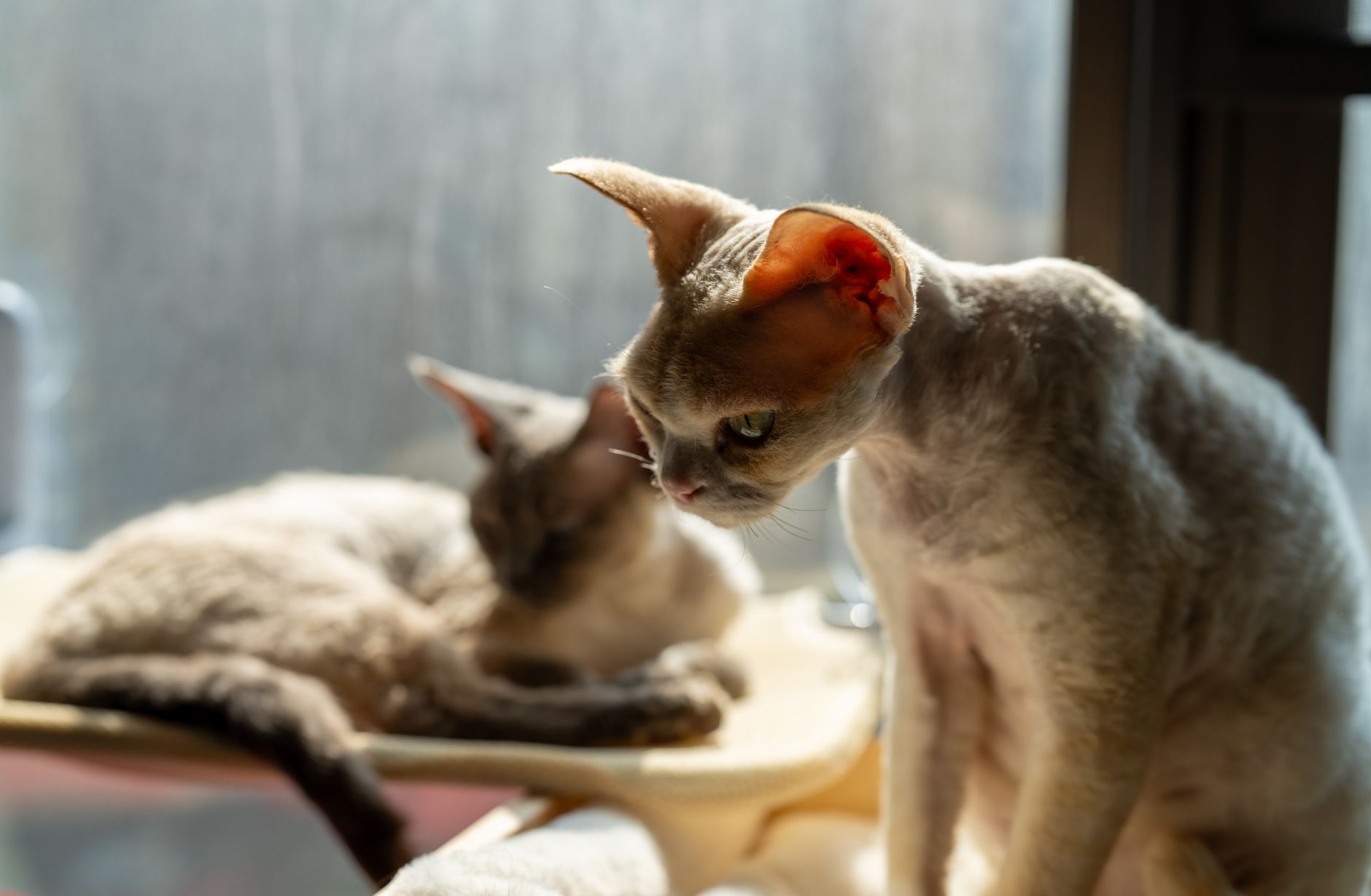
Temperature Control and Environmental Setup
Because they lack a standard insulating coat, these cats are highly sensitive to ambient temperature. If you are cold, they are freezing.
In my practice, I frequently treat Rexes for mild respiratory infections or lethargy that stem from a chilly home environment.
Creating a warm, safe microclimate in your home is essential for their well-being. This includes heated cat beds, sunny resting spots, and sometimes even custom-fitted sweaters.
You must also be cautious about sun exposure, as their thin coats leave them highly vulnerable to sunburn and squamous cell carcinoma.
- Place heated pet beds (with safety shut-offs) in draft-free areas of the home.
- Apply pet-safe, non-toxic sunscreen to ear tips and hairless areas if they enjoy sunbathing by windows.
- Ensure window glass has UV-blocking film to protect their sensitive skin from sun damage.
- Introduce sweaters gradually using positive reinforcement, ensuring they do not restrict movement or cause friction sores.
-
Purina Friskies Pate Wet Cat Food Variety PackA high-protein, complete diet suits cats’ needs as obligate carnivores
-
Depets Self-Cleaning Slicker BrushFine wire pins lift loose undercoat and work out small tangles before they turn into mats
-
Globlazer F70 Pro Heavy Duty Cat TreeGives cats vertical space to climb, scratch and nap, which reduces stress and keeps them off your shelves
Related Cat Guides
Frequently Asked Questions
Are Cornish Rex and Devon Rex cats hypoallergenic?
No, they are not completely hypoallergenic. While they shed less dander and hair than standard breeds, they still produce the Fel d 1 protein in their saliva, skin glands, and urine, which is the actual trigger for most cat allergies.
How often do Cornish and Devon Rex cats need baths?
Most of these cats require a bath every 2 to 4 weeks depending on their skin oil production. Skipping baths can lead to oily buildup, yeast infections, and a distinct rancid odor.
Do Cornish and Devon Rex cats lose their hair?
Yes, both breeds can go through periods of thinning hair or temporary baldness, often triggered by stress, hormonal shifts, or seasonal changes. This is colloquially called ‘fuzzing’ and is usually temporary, but should be evaluated by a vet to rule out underlying skin conditions.
Can these breeds go outside?
I strongly advise keeping them as indoor-only pets. Their thin coats provide virtually no protection against cold, heat, or solar radiation, making them highly susceptible to hypothermia and severe sunburn.
Are Cornish and Devon Rex cats good with dogs and kids?
Yes, their outgoing, confident, and highly social personalities make them excellent companions for respectful children and dog-friendly households. They thrive in busy environments where they can be the center of attention.
How can I tell the difference between a Cornish Rex and a Devon Rex?
Look at the ears and head shape. A Cornish Rex has a long, egg-shaped head with ears set high up, while a Devon Rex has a short, wedge-shaped head with prominent cheekbones and massive ears set low on the sides of the head.
Sources & Further Reading
- The Cat Fanciers’ Association (CFA)
- Cornell University College of Veterinary Medicine
- International Cat Care
- PetMD
Final Thoughts
Choosing between a Cornish Rex and a Devon Rex ultimately comes down to which aesthetic and structural profile resonates more with you. Both are incredibly loving, intelligent, and highly active companions that will keep you entertained for years.
However, you must be prepared for the unique dermatological, dietary, and thermal care these curly-coated breeds require. If you commit to their regular ear-cleaning, bathing, and calorie-dense nutritional needs, you will have a fiercely loyal ‘shadow’ by your side.
Always work closely with a veterinarian to keep your Rex healthy, warm, and thriving.