
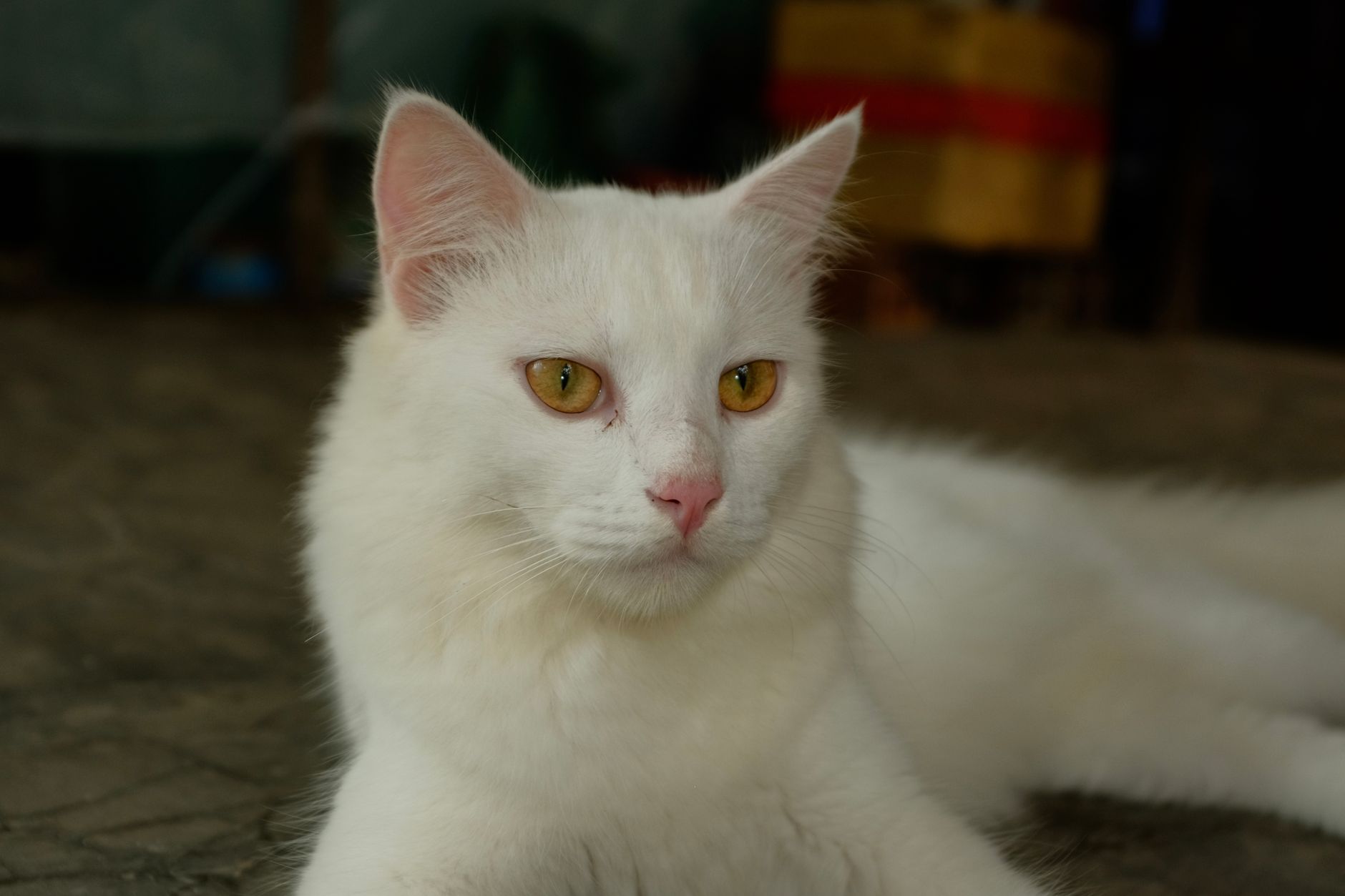
 Turkish Angora Deafness: Why White Cats Are at Risk” loading=”lazy”>
Quick Summary
Congenital sensorineural deafness in white Turkish Angora cats is a genetic condition closely linked to the dominant white (W) gene. This gene affects the development of hearing and pigment-producing cells, leaving blue-eyed white cats at the highest risk. Through professional BAER testing and simple home adaptations, deaf cats can live full, healthy, and safe indoor lives.
As an Amazon Associate, we earn from qualifying purchases.
Popular with cat owners: Kitten Food · Cat Tunnel · Slicker Brush
In my years of practicing veterinary medicine, few breeds have captured my heart quite like the Turkish Angora. Their elegance, silky coats, and spirited personalities make them truly remarkable companions.
However, behind that striking white coat lies a complex genetic puzzle that every owner and breeder must understand. Today, I want to demystify the science behind white coat genetics and hereditary deafness in this beautiful breed.
Key Takeaways
- The dominant white (W) gene is responsible for both the pure white coat and congenital deafness in Turkish Angoras.
- Deafness is caused by the degeneration of the inner ear’s stria vascularis within the first few weeks of life.
- White cats with blue eyes have a significantly higher statistical risk of deafness than those with amber or green eyes.
- The Brainstem Auditory Evoked Response (BAER) test is the only definitive, objective diagnostic tool for feline hearing.
- Deaf Turkish Angoras must live strictly indoors to protect them from environmental hazards they cannot hear.
- Training with visual hand signals, flashlights, and tactile vibrations allows for highly effective communication.
In This Article
- The Genetic Connection: The Dominant White Gene
- The Anatomy of Feline Hearing Loss
- Calculating the Risk: Eye Color and Statistics
- Diagnostic Testing: The Gold Standard BAER Test
- Living with a Deaf Turkish Angora: Safety First
- Sensory Enrichment for Hearing-Impaired Cats
- Breeding Ethics and Veterinary Recommendations
The Genetic Connection: The Dominant White Gene
When clients bring a white Turkish Angora kitten to my clinic, the very first thing we discuss is genetics. The majestic, snow-white coat of the Turkish Angora is not actually a color, but rather a genetic mask.
It is caused by the dominant white gene, represented by the letter ‘W’ in feline genetics.
This powerful gene acts pleiotropically, which means a single gene controls multiple, seemingly unrelated physical traits. In this case, the ‘W’ gene suppresses the migration of pigment-producing cells called melanocytes during early embryonic development.
This lack of pigment results in white fur, frequently produces striking blue eyes, and unfortunately, can disrupt the development of the inner ear.
How Melanocytes Protect Hearing
Melanocytes do far more than just color a cat’s fur and eyes. In the inner ear, these specialized cells are essential for maintaining the electrical potential of the fluid-filled chambers that process sound waves.
Purina ONE Healthy Kitten Dry Food
- ✓Real chicken is the #1 ingredient
- ✓DHA for vision and brain development
- ✓Easily digestible
- Higher protein and calories support a kitten’s rapid growth in the first year
Without them, the mechanical system of hearing simply collapses.

The Anatomy of Feline Hearing Loss
To truly understand why these cats lose their hearing, we have to look inside the microscopic structures of the feline ear. In my practice, I find that visualizing this anatomy helps owners realize why the condition is irreversible.
During the first week of a kitten’s life, the inner ear structures depend on a specialized vascular tissue layer called the stria vascularis. In kittens with the ‘W’ gene, the lack of melanocytes causes the stria vascularis to degenerate.
Without a blood supply, the delicate hair cells inside the Organ of Corti wither and die, permanently severing the connection to the auditory nerve.
- Stage 1 (Days 1-10): The stria vascularis fails to develop properly due to a lack of pigment cells.
- Stage 2 (Days 10-14): The blood supply to the inner ear’s cochlea is cut off.
- Stage 3 (Days 14-21): The vital sensory hair cells in the Organ of Corti begin to collapse and degenerate.
- Stage 4 (Day 28 onward): Auditory nerve fibers atrophy, resulting in permanent, irreversible sensorineural deafness.

Calculating the Risk: Eye Color and Statistics
A common misconception among cat owners is that every single white Turkish Angora is deaf. This is not the case, and the actual risk level is heavily correlated with the cat’s eye color.
In my clinical experience, evaluating iris pigmentation gives us a very strong indicator of the internal state of the ear. The same lack of melanocytes that turns the eyes blue also increases the likelihood of inner ear degeneration.
Odd-eyed cats, which have one blue eye and one green or amber eye, display a fascinating unilateral risk pattern.
- White cats with non-blue eyes: Approximately 17% to 20% are born deaf.
- Odd-eyed white cats (one blue eye): Approximately 40% are born deaf, typically only in the ear on the same side as the blue eye.
- Blue-eyed white cats (both eyes blue): Between 65% and 80% are born completely deaf.
- Non-white Turkish Angoras: Virtually 0% risk of congenital sensorineural deafness.
IAMS Proactive Health Kitten Dry Food
- ✓Made with real chicken
- ✓Supports whole-body health
- ✓High-quality protein for growth
- Higher protein and calories support a kitten’s rapid growth in the first year

Diagnostic Testing: The Gold Standard BAER Test
Many owners tell me they tested their kitten’s hearing at home by clapping or dropping keys. I always advise against relying on these home methods.
Cats are incredibly sensitive to air currents, shadows, and low-frequency floor vibrations, which can easily mimic a startle response to sound.
To get a definitive answer, we rely on the Brainstem Auditory Evoked Response, or BAER, test. This is the absolute gold standard in veterinary neurology for assessing hearing health in companion animals.
- Tiny, non-invasive electrode pins are placed just under the skin on the cat’s scalp.
- Small, comfortable foam inserts are gently placed into the cat’s ear canals.
- The machine delivers a series of clicking sounds directly into one ear at a time.
- The electrodes record the brain’s electrical activity, plotting a wave graph of the auditory pathway’s response.
- A flat line on the reading confirms complete sensorineural deafness in that ear.
When to Schedule a BAER Test
I recommend having Turkish Angora kittens tested at around five to six weeks of age. At this stage, the auditory pathways are fully developed, and the test can be performed safely without general anesthesia.

Living with a Deaf Turkish Angora: Safety First
Hearing-impaired cats do not know they are different, and they can lead incredibly joyful, interactive lives. However, as their human guardian, you must make critical adjustments to keep them safe.
The most important rule I give to my clients is that a deaf cat must never go outside unsupervised. Without the ability to hear oncoming cars, barking dogs, or wildlife, the outdoor world is a hostile environment.
- Keep your cat strictly indoors or restrict outdoor access to a fully enclosed patio (‘catio’) or secure harness.
- Always approach your cat from the front or within their peripheral vision to avoid startling them awake.
- Desensitize them to touch by gently tapping the floorboards near them before reaching out to pet them.
- Use bright visual cues, such as a quick double-click of a flashlight or a distinct hand wave, to signal meal times.
- Fit your cat with a safety breakaway collar labeled clearly with ‘Deaf Cat’ and your contact information.

Sensory Enrichment for Hearing-Impaired Cats
When one sense is lost, the others naturally become more acute. Your deaf Turkish Angora will rely heavily on their vision, smell, and sensitivity to physical vibrations.
To prevent behavioral issues like boredom-induced vocalization, we need to create an environment that stimulates these active senses. In my practice, I have seen bored deaf cats develop loud, nocturnal meowing habits because they cannot hear the volume of their own voices.
Proper enrichment is the key to solving this.
- Install high window perches and bird feeders to provide hours of ‘cat TV’ and visual stimulation.
- Use toys that move unpredictably, such as laser pointers, feather wands, and motorized prey toys.
- Incorporate scent play by offering catnip-marinated toys, silvervine sticks, or safe, fresh cat grass.
- Choose heavy-bottomed cat trees that allow vibrations to travel clearly when you tap on the base.
- Establish a highly consistent daily schedule to help your pet feel secure and confident in their environment.

Breeding Ethics and Veterinary Recommendations
From a veterinary medicine perspective, we must address how this genetic condition is managed at the breeder level. Responsible breeding is the only way to reduce the prevalence of congenital deafness in the Turkish Angora breed.
If you are looking to adopt a kitten, I highly encourage you to work only with preservation breeders who actively screen their breeding stock. Ethical breeders will BAER test every single kitten before they place them in a new home.
Mating Selection Guidelines
Ethical guidelines dictate that deaf cats should never be used for breeding. Breeders should also avoid mating two white cats, or mating white cats with blue eyes continuously, as this compounding genetic load dramatically spikes the incidence of deaf offspring.
-
EGETOTA 5-Way Cat Tunnel with Play BallA crinkly play tunnel gives cats somewhere to hide, pounce and race through
-
Hertzko Self-Cleaning Slicker BrushRemoves loose hair, tangles and dirt before they become mats
-
K&H EZ Mount Kitty Sill Window PerchA sunny lookout that entertains indoor cats for hours
Related Cat Guides
Frequently Asked Questions
Can a deaf Turkish Angora learn commands?
Absolutely. Deaf cats are highly intelligent and learn visual hand signals quickly. You can train them using thumbs-up signs for rewards, or distinct hand gestures for ‘come,’ ‘stop,’ and ‘no’ just as easily as you would with a hearing cat.
Are odd-eyed Turkish Angoras deaf in both ears?
Usually, odd-eyed cats are only deaf in one ear, which is known as unilateral deafness. The hearing loss almost always occurs in the ear on the same side as the blue eye, while the ear on the side of the green or amber eye has normal hearing.
Does my deaf cat require special medical treatment?
Deafness itself does not require medical treatment or medication. However, deaf cats are prone to solar dermatitis (sunburn) on their thin white ears, so you must protect them from excessive direct UV exposure to prevent skin cancers like squamous cell carcinoma.
Why does my deaf cat meow so loudly?
Because deaf cats cannot hear themselves, they are unable to regulate the volume of their vocalizations. They may meow very loudly or make unusual yowling noises, especially at night or when they are seeking attention or reassurances.
How can I wake up my deaf cat without scaring them?
To wake a sleeping deaf cat safely, avoid touching them directly right away. Instead, gently tap your foot on the floor nearby so they can feel the vibrations, or wave your hand closely in front of their nose so their sense of smell gently alerts them to your presence.
Sources & Further Reading
- The Cat Fanciers’ Association (CFA)
- Cornell University College of Veterinary Medicine
- Merck Veterinary Manual
- International Cat Care
Final Thoughts
A diagnosis of deafness is never a tragedy for a Turkish Angora; it is simply a unique trait that requires minor lifestyle adjustments from their human family. By understanding the underlying genetics of the dominant white gene and prioritizing a structured, enriched indoor environment, you can ensure your cat thrives.
Always advocate for ethical breeding, ask for diagnostic BAER testing, and enjoy the deep, uniquely visual bond you will form with your hearing-impaired pet. If you ever have concerns about your kitten’s hearing, do not hesitate to reach out to your primary care veterinarian for guidance.